
The Pilates 100s exercise, commonly known as “The Hundred,” is one of the most recognized movements in Pilates. It may look simple at first, but once you try it, you quickly understand why it has remained an important part of Pilates training for so long.
The exercise combines controlled arm movements, steady breathing, abdominal engagement, and body stability. Instead of performing large or fast movements, you hold your body in a controlled position while making small arm pumps. The traditional version uses a specific breathing pattern and finishes with 100 total arm pumps.
For beginners, the Pilates 100s exercise can feel surprisingly difficult. Your abdominal muscles may become tired, your breathing may require concentration, and your neck or shoulders may feel challenged if your technique is not correct. The good news is that The Hundred can be modified to match your fitness level.
This guide explains what the Pilates 100s exercise is, how to perform it correctly, which muscles it works, its potential benefits, beginner modifications, common mistakes, safety tips, and ways to make the movement easier or more challenging.
What Is the Pilates 100s Exercise?
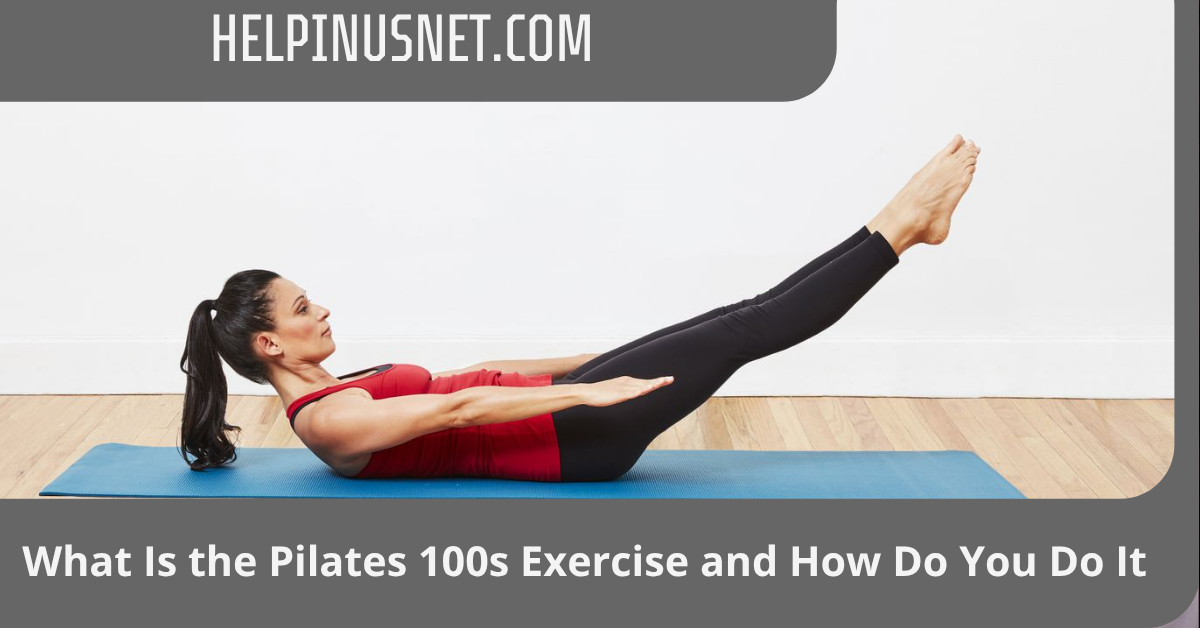
The Pilates 100s exercise is a classic mat Pilates movement that combines core stabilization, arm pumping, and controlled breathing.
You normally begin by lying on your back. Your legs are lifted or positioned in a modified position, your head and shoulders may be raised from the mat, and your arms reach forward. You then move your arms up and down in small, rhythmic pumps.
The traditional exercise uses 100 arm pumps.
The breathing pattern is usually divided into groups of 10:
- Five arm pumps while inhaling
- Five arm pumps while exhaling
- Repeat the pattern until you reach 100 arm pumps
The movement is not simply about moving your arms 100 times. The real challenge is keeping your body controlled while your arms and breathing continue working.
That combination makes The Hundred an excellent example of the Pilates focus on control, concentration, breathing, and precision.
A Brief History of the Pilates Hundred
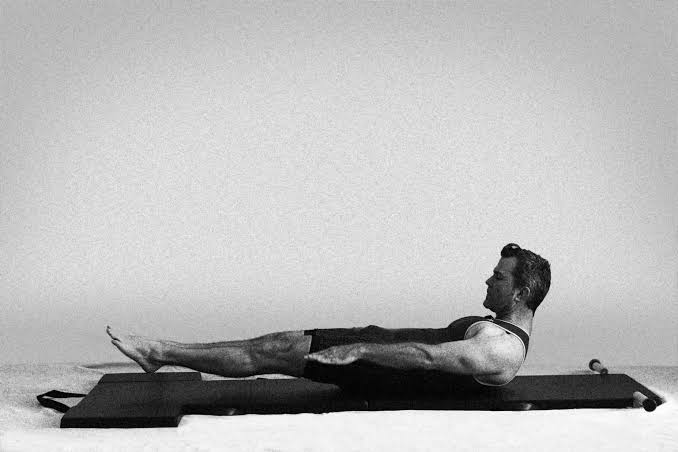
The Hundred comes from the original Pilates method developed by Joseph Pilates.
Joseph Pilates created a movement system that emphasized controlled exercise, breathing, concentration, body awareness, and physical conditioning. His method became known as Contrology.
The Hundred became one of the best-known exercises associated with this method.
It has traditionally been placed near the beginning of a Pilates mat routine because it prepares the body for additional movements. Modern Pilates classes, however, are not all structured in exactly the same way. Contemporary instructors may change the order, intensity, or version depending on the needs of their students.
This is important for beginners to understand. There is no requirement that every person perform The Hundred in exactly the same position.
Pilates has developed over time, and instructors often adapt exercises according to a person’s strength, mobility, experience, and comfort.
What Muscles Does the Pilates 100s Exercise Work?
The Pilates 100s exercise is best known as a core exercise, but several areas of the body contribute to the movement.
Abdominal Muscles
The abdominal muscles play a major role in maintaining your position.
The rectus abdominis, obliques, and deeper abdominal muscles help stabilize the trunk while the arms move.
Deep Core Muscles
The deeper muscles around the abdomen and trunk help provide stability.
These muscles are important because The Hundred requires you to maintain control rather than repeatedly moving your torso.
Hip Flexors
The hip flexors help hold the legs in the air.
They can become tired during the exercise, especially when the legs are extended.
If you feel excessive tension in the front of your hips, your leg position may be too demanding.
Shoulders and Arms
The arms perform repeated pumping movements, so the shoulder muscles and surrounding muscles are also involved.
The movement is small, but repeating it many times can create noticeable fatigue.
Back and Postural Muscles
The muscles around the spine and pelvis help stabilize your body.
They work together with the abdominal muscles to maintain your position throughout the exercise.
What Are the Benefits of the Pilates 100s Exercise?
The Pilates 100s exercise can be useful for several reasons.
However, it is important to keep expectations realistic. One exercise cannot provide every possible fitness benefit. The Hundred works best as one part of a complete exercise program.
1. Builds Core Endurance
One of the main benefits of The Hundred is its focus on abdominal endurance.
Instead of performing one quick movement after another, you maintain a controlled position for an extended period.
This teaches your core muscles to continue working without losing control.
2. Improves Breathing Coordination
Breathing is a major part of the exercise.
You must continue breathing while maintaining your body position and moving your arms.
This creates a coordination challenge that can improve your awareness of breathing during physical activity.
3. Develops Body Control
The Hundred requires you to keep your trunk relatively stable while your arms move.
This teaches an important movement skill: controlling one part of the body without creating unnecessary movement elsewhere.
4. Challenges Muscular Endurance
The repeated arm pumps and sustained body position can make your muscles tired.
This makes The Hundred an endurance-focused movement rather than simply a short strength exercise.
5. Encourages Better Body Awareness
Pilates places strong emphasis on paying attention to how your body moves.
During The Hundred, you need to notice your:
- Neck position
- Shoulder position
- Breathing
- Abdominal engagement
- Leg position
- Arm movement
- Pelvic stability
This can help you become more aware of your movement patterns.
6. Helps Prepare You for Other Pilates Exercises
Because The Hundred combines breathing, core engagement, and stability, it can prepare you for other Pilates movements that require similar skills.
It is particularly useful for learning how to maintain control while different parts of the body are working at the same time.
7. Can Support Overall Fitness
Pilates as a broader form of exercise can contribute to muscular endurance, flexibility, balance, coordination, and body awareness.
The Hundred should be viewed as one component of that larger system rather than a complete workout by itself.
How to Do the Pilates 100s Exercise
Learning the correct technique is more important than immediately trying to complete all 100 pumps.
Step 1: Lie on Your Back
Start on a comfortable exercise mat.
Lie on your back with your knees bent and your feet resting on the floor.
Take a few normal breaths.
Allow your shoulders to relax.
Step 2: Organize Your Body
Find a comfortable position for your spine and pelvis.
You do not need to force your lower back aggressively into the floor.
Instead, focus on creating a stable and controlled position.
Step 3: Lift Your Head and Shoulders
If you are ready for the traditional movement, gently lift your head and upper shoulders from the mat.
Keep your neck long.
Avoid pulling your chin aggressively toward your chest.
Your abdominal muscles should help support the movement.
Step 4: Position Your Legs
Your legs can be bent in a tabletop position or extended, depending on your experience and strength.
Beginners should generally start with the easier position.
The lower your legs are, the greater the challenge can become.
Step 5: Extend Your Arms
Reach your arms forward.
Keep them slightly above the mat.
Your elbows should remain comfortably straight.
Do not lock your joints aggressively.
Step 6: Start the Arm Pumps
Begin moving your arms up and down in small, controlled movements.
The movement should be rhythmic.
There is no need to swing your arms through a large range of motion.
Step 7: Coordinate Your Breathing
Use the traditional breathing pattern:
Inhale for five arm pumps.
Exhale for five arm pumps.
Continue this rhythm while maintaining your body position.
Step 8: Continue Toward 100 Pumps
Repeat the breathing and arm movements until you reach 100 pumps if you can do so comfortably.
If your technique starts to break down, stop earlier.
You can build up gradually over time.
Step 9: Finish Slowly
When you are finished, lower your head and shoulders with control.
Bring your legs back to a comfortable position.
Take a few normal breaths before moving on to another exercise.
How Should You Breathe During the Pilates Hundred?
Breathing is one of the most important parts of the Pilates 100s exercise.
The traditional pattern uses five counts for the inhale and five counts for the exhale.
You can think of it as:
“Five pumps in, five pumps out.”
The goal is to maintain a steady rhythm.
Do not hold your breath to complete the exercise.
If the breathing pattern feels difficult at first, practice the breathing separately before adding the arm movement.
You can also perform fewer cycles until the breathing becomes more natural.
Pilates 100s Exercise for Beginners
If you are new to Pilates, you do not need to perform the most advanced version of The Hundred.
Start by learning the individual parts.
First, practice lying comfortably on your back.
Then practice controlled breathing.
Next, add small arm movements.
Once that feels comfortable, practice holding your legs in a supported position.
Finally, add the head and shoulder lift if you can do it comfortably.
This gradual approach can make the exercise much easier to learn.
Beginner Pilates Hundred Modification
One of the easiest ways to modify The Hundred is to keep your feet on the floor.
Lie on your back with your knees bent.
Lift your head and shoulders only if you can do so comfortably.
Extend your arms and perform the small pumps.
Focus on breathing rather than the number of repetitions.
This variation removes some of the difficulty created by holding your legs in the air.
Tabletop Pilates Hundred
Another popular modification is the tabletop position.
Bring your knees above your hips and bend your knees approximately 90 degrees.
Your lower legs can remain roughly parallel to the floor.
This gives your core a manageable challenge without requiring your legs to be fully extended.
For many beginners, tabletop is a useful middle step between feet-on-the-floor and fully extended legs.
Pilates Hundred With the Head Down
You do not have to keep your head lifted.
If your neck becomes tired, keeping your head on the mat can make the movement much more comfortable.
You can still practice:
- Arm pumps
- Breathing
- Abdominal control
- Leg positioning
Once your core endurance improves, you may be able to add the head and shoulder lift.
How to Make the Pilates Hundred Easier
If the traditional exercise is too difficult, try one or more of these changes:
- Keep your feet on the floor.
- Bend your knees.
- Keep your head down.
- Perform fewer arm pumps.
- Reduce the length of each set.
- Take a short rest between cycles.
- Focus on breathing before increasing intensity.
There is nothing wrong with using an easier version.
A modification is not a failure. It is a way to make an exercise appropriate for your current ability.
How to Make the Pilates Hundred Harder
Once you have developed good control, you can gradually increase the challenge.
You may:
- Extend your legs.
- Lower your legs slightly.
- Increase the number of cycles.
- Maintain the position for longer.
- Improve the precision of your arm pumps.
- Reduce unnecessary movement in your trunk.
The important point is to change only one difficulty factor at a time.
Do not immediately lower your legs, increase your repetitions, and hold the position longer.
Progress should be gradual.
Common Pilates Hundred Mistakes
The Hundred is simple in appearance but easy to perform incorrectly.
Pulling the Neck Forward
If you push your chin toward your chest, your neck may become tense.
Instead, imagine creating length through the back of your neck.
Dropping the Legs Too Low
Lower legs increase the challenge.
However, if your lower back begins to lose control, the position may be too difficult.
Raise your legs or bend your knees.
Pumping the Arms Too Aggressively
The arm movement should be small and controlled.
Large, fast movements can cause your torso to move unnecessarily.
Holding Your Breath
Some beginners unconsciously hold their breath when the exercise becomes difficult.
Try to maintain the breathing rhythm.
If you cannot breathe comfortably, reduce the difficulty.
Shrugging the Shoulders
Avoid bringing your shoulders toward your ears.
Keep the shoulder area relaxed as much as possible.
Trying to Reach 100 at Any Cost
The number 100 is traditional, but it is not more important than proper form.
Thirty good repetitions are more useful than 100 uncontrolled repetitions.
Using Momentum
The exercise should not become a frantic movement.
Controlled repetition is one of the main ideas behind Pilates.
Pilates 100s Exercise and Core Strength
The Hundred is often described as a core-strength exercise, but core endurance is an especially important part of it.
Strength means producing force.
Endurance means maintaining muscular work over time.
The Hundred requires your core to remain active while your arms repeatedly move and your breathing continues.
This makes it particularly useful for practicing sustained trunk control.
It also teaches you how to maintain stability while another part of the body is moving.
Does the Pilates Hundred Work Your Abs?
Yes, the abdominal muscles play a major role in The Hundred.
However, the exercise does not isolate your abs.
Your hips, shoulders, arms, back, and breathing muscles also contribute.
The exact muscles you feel can vary based on your technique and body position.
For example, someone using an advanced leg position may feel more work around the hips, while someone using a beginner modification may notice more abdominal control without as much hip demand.
Can the Pilates Hundred Give You a Six-Pack?
The Pilates Hundred can train your abdominal muscles, but no single exercise can guarantee visible abs.
Visible abdominal definition depends on several factors, including genetics, overall body composition, muscle development, nutrition, and total physical activity.
Therefore, The Hundred should not be viewed as a special exercise for removing belly fat.
It is more accurate to think of it as a movement for core endurance, control, coordination, and breathing.
Can the Pilates Hundred Help With Weight Loss?
The Hundred can be part of an active lifestyle, but it should not be treated as a stand-alone weight-loss solution.
Weight management is influenced by overall energy intake, physical activity, sleep, genetics, lifestyle habits, and other factors.
Pilates can help you stay active and develop strength and endurance.
For broader fitness and weight-management goals, combine Pilates with other forms of movement, such as walking, strength training, or appropriate cardiovascular exercise.
Pilates Hundred vs. Crunches
The Hundred and a crunch both involve the abdominal area, but they use different movement strategies.
A traditional crunch repeatedly moves the spine through flexion.
The Hundred focuses more on maintaining a controlled position while the arms move and breathing continues.
This makes the Hundred more of a stability and endurance challenge.
Neither exercise is automatically better for every person.
Your choice should depend on your goals, comfort, fitness level, and ability to perform the movement correctly.
How Often Should You Do the Pilates Hundred?
There is no universal rule saying you must perform The Hundred every day.
Your ideal frequency depends on your overall Pilates routine and fitness level.
Beginners may practice it several times per week as part of a larger routine.
If you are already experienced with Pilates, you may include it more frequently if it feels comfortable.
However, repeating the same movement constantly is not necessary for progress.
A balanced routine that includes different exercises is usually more useful.
Is the Pilates Hundred Safe?
For many healthy adults, The Hundred can be a reasonable exercise when performed with appropriate technique.
However, no exercise is automatically suitable for every person.
Extra caution may be appropriate if you have:
- Current neck pain
- Back pain
- A recent injury
- Recent surgery
- Significant joint problems
- Pregnancy-related exercise restrictions
- A medical condition affecting exercise tolerance
In these situations, an appropriately trained healthcare or fitness professional can help determine whether a modification is suitable.
Stop if you experience sharp pain, dizziness, unusual shortness of breath, or another concerning symptom.
Pilates Hundred for Older Adults
Older adults can practice Pilates, but the exercise should match their individual fitness and mobility level.
The traditional Hundred may not be the best starting point for everyone.
A modified version with the head down, knees bent, or feet supported may be more appropriate.
The goal should be to build control gradually.
Age alone does not determine whether someone can perform an exercise. Individual strength, mobility, balance, health status, and exercise experience are much more important.
Pilates Hundred During Pregnancy
Pregnancy can change how a person should approach abdominal exercises.
The traditional Hundred involves a position that may not be appropriate for everyone during pregnancy, especially as pregnancy progresses.
Anyone who is pregnant should follow individualized advice from a qualified healthcare professional or appropriately trained prenatal exercise specialist.
Do not assume that an exercise is safe during pregnancy simply because it is commonly performed in Pilates classes.
Frequently Asked Questions About the Pilates 100s Exercise
1. What is the best time of day to do the Pilates Hundred?
There is no single best time. The most useful time is one that fits your schedule and allows you to exercise consistently. Some people prefer morning workouts, while others feel stronger later in the day.
2. Should I eat before doing the Pilates Hundred?
That depends on your personal comfort and the size of your meal. Avoid exercising immediately after a large meal because lying down and performing abdominal movements may feel uncomfortable. Give your body enough time to digest.
3. Can men do the Pilates Hundred?
Absolutely. The Pilates Hundred is not designed for one gender. Men and women can both use Pilates to develop core endurance, coordination, flexibility, strength, and body awareness.
4. Why do my hip flexors work so much during the Hundred?
Your hip flexors help support the legs when they are held in the air. If they become overly dominant or uncomfortable, try bending your knees, raising your legs, or using a less demanding variation.
5. Do I need Pilates equipment to perform the Hundred?
No. The basic Pilates Hundred can be performed on a comfortable exercise mat without specialized equipment. Additional Pilates equipment may be used in other variations, but it is not necessary for the basic movement.
Conclusion
The Pilates 100s exercise is a classic movement for a reason. It combines several important Pilates skills in one relatively simple exercise: breathing, core control, concentration, coordination, stability, and muscular endurance.
Although the traditional version involves 100 arm pumps, the number should never be more important than your technique. Beginners can start with fewer repetitions, bent knees, feet on the floor, or the head resting on the mat. As your strength and control improve, you can gradually move toward a more challenging version.
The Hundred can help develop abdominal endurance and body awareness, but it should not be treated as a magic exercise for weight loss, visible abs, or perfect posture. Its greatest value comes from how it fits into a complete Pilates or fitness routine.
If you are new to Pilates, start slowly and pay attention to how your body feels. Keep your breathing steady, avoid unnecessary tension, and choose the version you can perform with control.
In Pilates, doing less with better control is often more valuable than doing more without it.
