
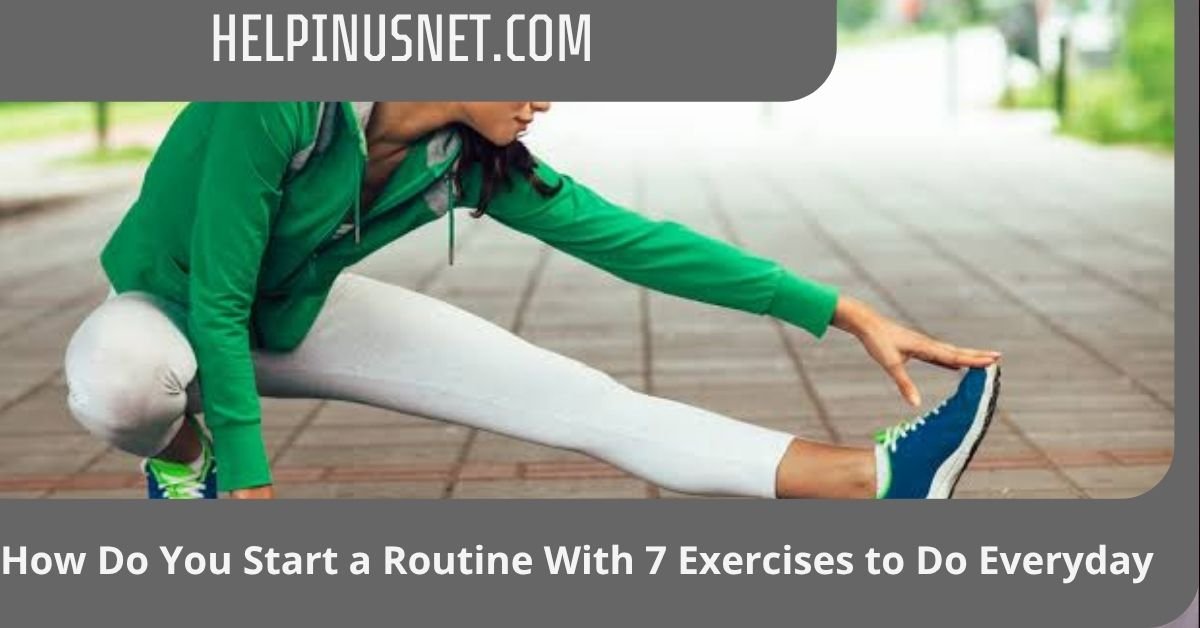
Finding time to exercise can be difficult. Busy work schedules, family responsibilities, long commutes, and screen time can all make physical activity feel like another task on a long list. The good news is that you do not need a complicated gym program to move more each day.
A simple routine built around basic movements can help support strength, flexibility, balance, mobility, and cardiovascular fitness. For many healthy adults, a short daily movement routine can also make it easier to build a consistent exercise habit.
This guide explains 7 exercises to do everyday that can be adapted for different fitness levels. It is designed especially for people who want a practical routine they can perform at home with little or no equipment.
The exercises include squats, push-ups, walking or marching in place, glute bridges, bird dogs, planks, and mobility exercises. The goal is not to perform every movement at maximum intensity every day. Instead, the goal is to move consistently while allowing your body enough recovery when needed.
What Are the 7 Exercises to Do Everyday?
A simple daily routine can include these seven movements:
- Squats
- Push-ups
- Walking or marching in place
- Glute bridges
- Bird dogs
- Planks
- Full-body mobility exercises
These exercises cover several major areas of fitness. Squats and glute bridges train the lower body, push-ups train the upper body, planks and bird dogs challenge the core, walking supports cardiovascular health, and mobility exercises help maintain comfortable movement.
For beginners, each exercise can be modified. You might start with five to ten repetitions or a short time period and gradually increase the amount as your fitness improves.

Why Daily Exercise Matters
Regular physical activity is associated with many important health benefits. Exercise can help maintain healthy muscles and bones, support cardiovascular fitness, improve physical function, and contribute to better overall well-being.
However, “everyday exercise” does not have to mean doing a hard workout seven days a week.
There is an important difference between daily movement and daily intense training.
A light walk, gentle stretching session, or mobility routine can be appropriate on a recovery day, while demanding strength workouts may require more recovery time.
The most useful routine is usually one that you can perform consistently and safely.
For adults in the United States, federal physical activity recommendations generally emphasize getting regular aerobic activity along with muscle-strengthening activity during the week. A daily seven-exercise routine can complement those goals, but it should not be viewed as a replacement for all forms of physical activity.
7 Exercises to Do Everyday for Beginners
If you are searching for 7 exercises to do everyday for beginners, start with simple versions of each movement. You do not need to complete a large number of repetitions.
A beginner-friendly starting point might look like this:
| Exercise | Beginner Starting Point | Main Focus |
| Squats | 8–10 reps | Legs and hips |
| Push-ups | 5–10 reps | Chest, shoulders, arms |
| Walking/marching | 5–10 minutes | Cardiovascular fitness |
| Glute bridges | 8–12 reps | Glutes and hips |
| Bird dogs | 5–8 each side | Core and balance |
| Plank | 10–20 seconds | Core stability |
| Mobility exercises | 5 minutes | Flexibility and movement |
These are starting suggestions rather than strict requirements. Your appropriate amount depends on your age, fitness level, health, training history, and goals.
1. Squats
Squats are one of the most useful bodyweight exercises because they train movements that people perform in everyday life, such as sitting down and standing up.
A basic bodyweight squat primarily works the quadriceps, glutes, and other muscles around the hips and legs. It also requires coordination and trunk control.
How to Do a Bodyweight Squat
- Stand with your feet approximately shoulder-width apart.
- Keep your chest comfortably lifted.
- Brace your abdominal muscles gently.
- Push your hips back and bend your knees.
- Lower yourself as far as you can comfortably control.
- Keep your feet planted on the floor.
- Push through your feet to return to standing.
You do not need to squat extremely low. Your comfortable range of motion is more important than forcing depth.
Beginner Squat Modification
If regular squats feel difficult, try chair squats.
Stand in front of a sturdy chair. Slowly lower your body toward the chair, lightly touch the seat, and stand again.
The chair provides a useful reference point and can make the movement easier to control.
Common Squat Mistakes
Beginners sometimes try to copy the squat depth or speed of experienced athletes. This is unnecessary.
Common problems include:
- Moving too quickly
- Losing control at the bottom
- Allowing the knees to collapse inward
- Lifting the heels
- Using more range of motion than you can comfortably control
Focus on smooth, controlled repetitions.
2. Push-Ups
Push-ups are a classic bodyweight exercise for the upper body. They primarily challenge the chest, shoulders, and triceps while requiring the abdominal and other stabilizing muscles to help maintain body position.
A standard push-up can be challenging for beginners, so modifications are completely acceptable.
How to Do a Push-Up
- Place your hands slightly wider than shoulder width.
- Extend your legs behind you.
- Keep your body in a relatively straight line.
- Tighten your abdominal muscles gently.
- Bend your elbows and lower your chest toward the floor.
- Stop at a comfortable depth.
- Press through your hands to return to the starting position.
Do not worry if you cannot perform a full push-up initially.
Beginner Push-Up Options
You can make push-ups easier by performing them against:
- A wall
- A sturdy countertop
- A stable bench
- The floor from your knees
Wall push-ups are often a good starting point because they reduce the amount of body weight you need to move.
As your strength improves, you can gradually move toward lower surfaces and eventually standard floor push-ups.
How Many Push-Ups Should You Do?
There is no universal number that everyone should perform every day.
A beginner might start with one or two sets of five repetitions. Someone with more experience may comfortably perform more.
Stop before your technique breaks down. Quality is generally more useful than simply chasing a high repetition number.
3. Walking or Marching in Place
Walking is one of the simplest forms of physical activity.
You can walk outdoors, around your home, at a shopping center, or on a treadmill. When walking outside is not convenient, marching in place can provide an easy alternative for getting your body moving.
Walking is particularly useful because it can be adjusted to different fitness levels.
How to March in Place
- Stand comfortably.
- Lift one foot from the floor.
- Lower it and lift the opposite foot.
- Continue alternating.
- Swing your arms naturally.
- Gradually increase your pace if comfortable.
You can perform this exercise for several minutes.
For a more challenging version, lift your knees slightly higher or increase your pace while maintaining control.
Why Walking Belongs in a Daily Exercise Routine
Walking can help you accumulate aerobic activity without requiring specialized equipment.
It can also be divided into shorter sessions. For example, instead of trying to complete one long exercise session, you might walk for several minutes in the morning, during a lunch break, and in the evening.
This approach can make physical activity easier to fit into a busy schedule.
4. Glute Bridges
Glute bridges are a simple floor exercise that focuses on the muscles around the hips and buttocks. They also require some contribution from the hamstrings and core.
They can be useful for people who spend much of the day sitting because they provide an opportunity to move the hips through a different pattern.
How to Do a Glute Bridge
- Lie on your back.
- Bend your knees.
- Place your feet flat on the floor.
- Keep your feet roughly hip-width apart.
- Gently tighten your abdominal muscles.
- Press your feet into the floor.
- Lift your hips toward the ceiling.
- Pause briefly.
- Lower your hips slowly.
You should not need to arch your lower back aggressively to lift your hips.
Think about moving from your hips rather than trying to push your stomach upward.
Beginner Glute Bridge Routine
Start with approximately 8–12 controlled repetitions.
If that feels easy, you can gradually add repetitions or another set.
Later, more advanced variations can include single-leg bridges, but beginners generally benefit from mastering the basic movement first.
5. Bird Dogs
The bird dog is a useful bodyweight movement for developing core control, balance, and coordination.
Unlike exercises that simply hold the body still, the bird dog requires you to move your limbs while maintaining a stable torso.
How to Do a Bird Dog
- Begin on your hands and knees.
- Place your hands under or near your shoulders.
- Position your knees under or near your hips.
- Brace your core gently.
- Extend one arm forward.
- Extend the opposite leg backward.
- Pause briefly.
- Return to the starting position.
- Repeat on the opposite side.
Move slowly rather than trying to lift your arm and leg as high as possible.
The objective is controlled movement.
What Does the Bird Dog Work?
The bird dog challenges muscles involved in:
- Core stability
- Hip stability
- Shoulder stability
- Balance
- Coordination
It is particularly useful as a low-equipment movement because it combines several fitness qualities in one exercise.
6. Planks
Planks are an isometric exercise, meaning the muscles work while you hold a position rather than repeatedly moving through a range of motion.
They are commonly used to challenge core endurance.
How to Perform a Basic Plank
- Start on your hands and knees.
- Place your forearms on the floor.
- Extend your legs behind you.
- Keep your body relatively straight.
- Tighten your abdominal muscles.
- Breathe normally.
- Hold the position for a comfortable period.
- Lower yourself when your technique begins to deteriorate.
Beginners do not need to hold a plank for several minutes.
A 10- to 20-second hold can be a reasonable starting point for someone who is new to the movement.
Easier Plank Variation
Try a knee plank.
Keep your knees on the floor while supporting your upper body with your forearms. This reduces the amount of body weight that needs to be supported.
You can gradually increase the duration as your core endurance improves.
A Better Way to Think About Plank Duration
Longer is not automatically better.
If your hips sag, your shoulders become uncomfortable, or you have difficulty maintaining your position, the exercise has become less useful.
Several short, well-controlled holds can be more practical than one very long hold performed with poor technique.
7. Full-Body Mobility Exercises
The seventh part of this routine is mobility work.
Mobility exercises involve controlled movement through a joint’s available range. They can include movements for the shoulders, hips, spine, ankles, and other areas.
Examples include:
- Arm circles
- Shoulder rolls
- Gentle torso rotations
- Hip circles
- Ankle circles
- Controlled leg swings
- Cat-cow movements
- Gentle bodyweight lunges
You can spend around five minutes moving through several comfortable mobility exercises.
Why Mobility Matters
Strength and cardiovascular fitness are important, but comfortable movement is also part of physical fitness.
Mobility work can be particularly helpful before exercise as part of a warm-up. Gentle movement can also be used during breaks from prolonged sitting.
Mobility exercises should generally feel controlled rather than forced.
Avoid bouncing aggressively into uncomfortable positions.
How to Turn These 7 Exercises Into a Daily Routine
Knowing the exercises is only part of the process. The bigger challenge is creating a routine you can actually maintain.
Here is one simple structure:
5-Minute Version
For very busy days:
- 1 minute of marching
- 8 squats
- 5 push-ups or wall push-ups
- 8 glute bridges
- 5 bird dogs per side
- 10-second plank
- 1 minute of mobility
This is a starting framework, not a required prescription.
10-Minute Version
If you have more time:
- March for 2 minutes.
- Perform 10 squats.
- Perform 5–10 push-ups.
- Perform 10 glute bridges.
- Perform 6 bird dogs per side.
- Hold a plank for 15–30 seconds.
- Finish with 2–3 minutes of mobility.
You can repeat some exercises if you feel comfortable doing so.
20-Minute Version
For a longer session, consider performing two rounds.
You can also increase your walking time and include additional mobility work.
Remember that a longer workout is not necessarily a better workout. The right amount depends on your fitness level and overall weekly activity.
Should You Really Do These 7 Exercises Every Day?
This is one of the most important questions surrounding the phrase “7 exercises to do everyday.”
You can perform light versions of many movements daily, but you do not necessarily need to perform the same challenging strength workout every day.
Muscles need recovery after demanding exercise. If you perform a difficult strength session, repeating the same high-effort routine every day may not provide enough recovery.
A practical approach is to vary the intensity.
For example:
- Monday: Full routine
- Tuesday: Light routine and walking
- Wednesday: Full routine
- Thursday: Mobility and walking
- Friday: Full routine
- Saturday: Walking and light exercises
- Sunday: Gentle mobility or rest
This approach keeps movement consistent without requiring intense training every day.
How Much Exercise Do Adults Need?
The seven exercises above should be viewed as a simple routine rather than a complete definition of physical fitness.
Adults generally benefit from combining aerobic activity with muscle-strengthening activities throughout the week.
Aerobic activities can include:
- Brisk walking
- Cycling
- Swimming
- Dancing
- Jogging
- Hiking
Strength activities can include:
- Bodyweight exercises
- Resistance bands
- Free weights
- Weight machines
The amount and intensity should be appropriate for your fitness level and health status.
A short daily routine can be a useful starting point, especially for people who currently do very little activity.
7 Exercises to Do Everyday Without Equipment
One major advantage of this routine is that most movements require no gym equipment.
You can perform:
- Squats without weights
- Wall or floor push-ups
- Marching in place
- Glute bridges
- Bird dogs
- Planks
- Mobility movements
This makes the routine suitable for many home environments.
However, “no equipment” does not mean “no preparation.”
Make sure you have enough room to move safely. Use a stable surface for exercises that require support, such as chair squats or countertop push-ups.
How Beginners Can Progress Safely
If you are new to exercise, avoid the temptation to do too much immediately.
A simple progression might look like this:
Week 1
Focus on learning proper movement patterns.
Perform one set of each exercise and keep the intensity comfortable.
Week 2
Gradually add a few repetitions or increase your walking time.
Week 3
Add another set to selected exercises if you are recovering well.
Week 4
Increase difficulty gradually by using more challenging variations.
Progression does not always mean doing more repetitions.
You can progress by:
- Improving technique
- Increasing control
- Increasing walking duration
- Adding resistance
- Using a more challenging variation
- Reducing unnecessary rest
There is no need to progress every variable at once.
How to Know if an Exercise Is Too Difficult
Exercise can feel challenging without being unsafe.
Pay attention to the difference between normal exertion and warning signs.
Normal exercise sensations can include:
- Faster breathing
- Increased heart rate
- Muscle fatigue
- Sweating
- A feeling that the muscles are working
Stop exercising and seek appropriate medical attention if you experience concerning symptoms such as chest pain, fainting, severe shortness of breath, or other unusual symptoms.
People with known health conditions, recent injuries, or concerns about starting exercise should consider discussing an appropriate activity plan with a qualified healthcare professional.
Do You Need to Stretch Every Day?
Stretching and mobility are related but are not exactly the same.
Static stretching generally involves holding a muscle in a lengthened position. Mobility exercises often involve actively moving through a range of motion.
You do not necessarily need a long stretching session every day.
A few minutes of gentle mobility can be a practical addition to a daily routine.
After exercise, some people enjoy gentle static stretching. It can feel relaxing, although stretching should not be painful.
Best Time of Day to Do These Exercises
There is no single best time that works for everyone.
Some people prefer exercising in the morning because it helps them establish a routine before the day becomes busy.
Others prefer lunchtime or evening exercise.
The best time is often the time you can consistently maintain.
If your schedule is unpredictable, consider dividing your movement into small sessions.
For example:
- Morning: 5 minutes of exercises
- Afternoon: 10-minute walk
- Evening: 5 minutes of mobility
Small amounts can add up.
7 Exercises to Do Everyday for Weight Management
Exercise can support weight management, but it is important to avoid promising that a specific seven-exercise routine will automatically cause weight loss.
Body weight is influenced by many factors, including food intake, activity, sleep, genetics, medications, health conditions, and overall lifestyle.
Walking and resistance exercises can contribute to total physical activity.
Strength training can also help maintain muscle while a person is trying to manage body weight.
For weight-related goals, focus on sustainable habits rather than trying to burn as many calories as possible in a short workout.
Can These Exercises Build Muscle?
They can contribute to muscular strength and endurance, particularly for beginners.
However, muscle growth depends on factors such as training intensity, progressive overload, nutrition, recovery, and individual characteristics.
Bodyweight exercises can become challenging enough to stimulate progress, especially when someone is new to resistance training.
As you become stronger, you may eventually need more resistance or more difficult exercise variations to continue progressing.
For example, basic squats can eventually progress to weighted squats, split squats, or other resistance exercises.
Can You Do These Exercises at Home?
Yes.
One of the biggest advantages of this routine is that it can be performed at home.
You generally need:
- Comfortable clothing
- Enough floor space
- A stable surface
- A few minutes of time
A yoga mat can make floor exercises more comfortable, but it is not essential.
If you use furniture for support, make sure it is stable and cannot easily slide.
How to Make Daily Exercise a Habit
Exercise habits are easier to maintain when they are simple.
Instead of thinking, “I need to complete a huge workout,” create a small daily starting point.
For example:
“After I brush my teeth in the morning, I will do five squats.”
Once the habit becomes automatic, you can expand it.
Other strategies include:
Keep the Routine Short
A routine that takes 10 minutes may be easier to maintain than one that requires an hour.
Attach Exercise to an Existing Habit
You can exercise after:
- Waking up
- Lunch
- Work
- A daily walk
- Preparing dinner
Keep Expectations Realistic
Missing one day does not mean you failed.
Simply return to the routine when you can.
Track Progress
You can record:
- Number of repetitions
- Walking time
- Plank duration
- How the exercises feel
- Number of days completed
Tracking can help you see gradual improvement.
Common Mistakes When Starting a Daily Exercise Routine
A few common mistakes can make a simple routine unnecessarily difficult.
Doing Too Much Too Soon
A beginner does not need to complete hundreds of repetitions.
Start with a manageable amount.
Ignoring Recovery
More exercise is not always better. Recovery is part of training.
Prioritizing Repetitions Over Technique
Ten controlled repetitions are generally more useful than twenty rushed repetitions.
Comparing Yourself With Others
Fitness levels differ widely.
Your starting point is your starting point.
Exercising Through Serious Pain
Normal muscle effort is different from sharp or severe pain.
If something feels wrong, stop and assess the situation.
How to Modify the Routine for Different Fitness Levels
The same seven exercises can be adapted.
Beginner
Use:
- Chair squats
- Wall push-ups
- Slow marching
- Basic glute bridges
- Short bird-dog holds
- Knee planks
- Gentle mobility
Intermediate
Try:
- Deeper controlled squats
- Standard push-ups
- Faster walking
- Longer bridges
- More controlled bird dogs
- Longer planks
- More active mobility work
More Advanced
You may add:
- Resistance
- More difficult variations
- Longer aerobic sessions
- More sets
- Additional strength exercises
Advanced exercisers should still prioritize recovery and proper technique.
Is 10 Minutes of Exercise a Day Enough?
Ten minutes is better than doing nothing, especially if it helps you become more active.
However, a 10-minute routine should not automatically be considered enough for every person’s fitness goals.
Someone training for a marathon, building significant strength, or preparing for a sport will need a more specialized program.
For someone who currently has a sedentary lifestyle, however, a short daily routine can be a realistic first step toward greater physical activity.
How Walking and Strength Exercises Work Together
Walking and strength training provide different types of physical benefits.
Walking primarily provides aerobic activity and helps you remain active throughout the day.
Strength exercises challenge muscles through resistance.
Combining both can create a more balanced routine.
For example, you might perform the six strength and mobility movements in this article for 10 minutes and then take a 20-minute walk.
That gives you a simple combination of resistance-oriented movement and aerobic activity.
What Should You Do on a Rest Day?
Rest does not always have to mean complete inactivity.
Depending on your training and fitness level, a rest day could include:
- Easy walking
- Gentle stretching
- Light mobility
- Normal daily activities
If you are very tired or recovering from a demanding workout, taking a complete rest day may be appropriate.
Listen to your body and consider your overall training schedule.
When Should You Increase the Difficulty?
Increase difficulty when the current version feels consistently manageable and you can maintain good technique.
For example, if you can comfortably perform your planned squats with excellent control, you might increase repetitions or use a more difficult variation.
For planks, you can gradually increase the hold time.
For walking, you can increase duration or pace.
Progress should be gradual rather than sudden.
Frequently Asked Questions About 7 Exercises to Do Everyday
1. Can I do these seven exercises if I have never exercised before?
Yes, many of these movements can be modified for beginners. Start with easy versions, such as chair squats and wall push-ups, and use short sessions. The goal at first should be learning comfortable movement patterns rather than reaching a specific performance target.
2. Should I do all seven exercises in the same order?
No. There is no requirement to use one specific order. A practical approach is to begin with a short warm-up or walking period, perform strength-focused movements, and finish with mobility work. You can also organize the exercises based on your available time and comfort.
3. Can I replace one of the exercises with another activity?
Yes. Exercise routines can be individualized. For example, if a particular movement is uncomfortable or unsuitable for you, a qualified professional can help identify an appropriate alternative that trains a similar physical quality.
4. Is it better to exercise every day or three times a week?
It depends on what “exercise” means. Light daily movement can be beneficial, while demanding strength training may require recovery days. A balanced weekly schedule can include regular aerobic activity, strength training, and easier recovery-focused movement.
5. Can children or older adults follow the same seven-exercise routine?
Not necessarily in the same form. Exercise needs vary considerably with age, development, balance, fitness, health conditions, and previous activity. Children and older adults may need age-appropriate modifications and, in some circumstances, professional guidance.
Conclusion
The best exercise routine is not necessarily the most complicated one. A simple program that you can perform consistently can be a useful foundation for becoming more physically active.
These 7 exercises to do everyday provide a practical combination of lower-body strength, upper-body strength, core stability, balance, cardiovascular movement, and mobility.
The seven movements are:
- Squats
- Push-ups
- Walking or marching in place
- Glute bridges
- Bird dogs
- Planks
- Full-body mobility exercises
Beginners should start slowly and modify exercises when necessary. You do not need to perform a hard workout every day. Instead, consider using different levels of intensity throughout the week and giving your body enough time to recover.
Most importantly, think beyond a single workout. Walking more, taking movement breaks, reducing long periods of sitting, and choosing activities you enjoy can all contribute to a more active lifestyle.
If you are new to exercise, start with a small routine that feels achievable. Over time, consistency can turn those few daily minutes into a lasting fitness habit.
