
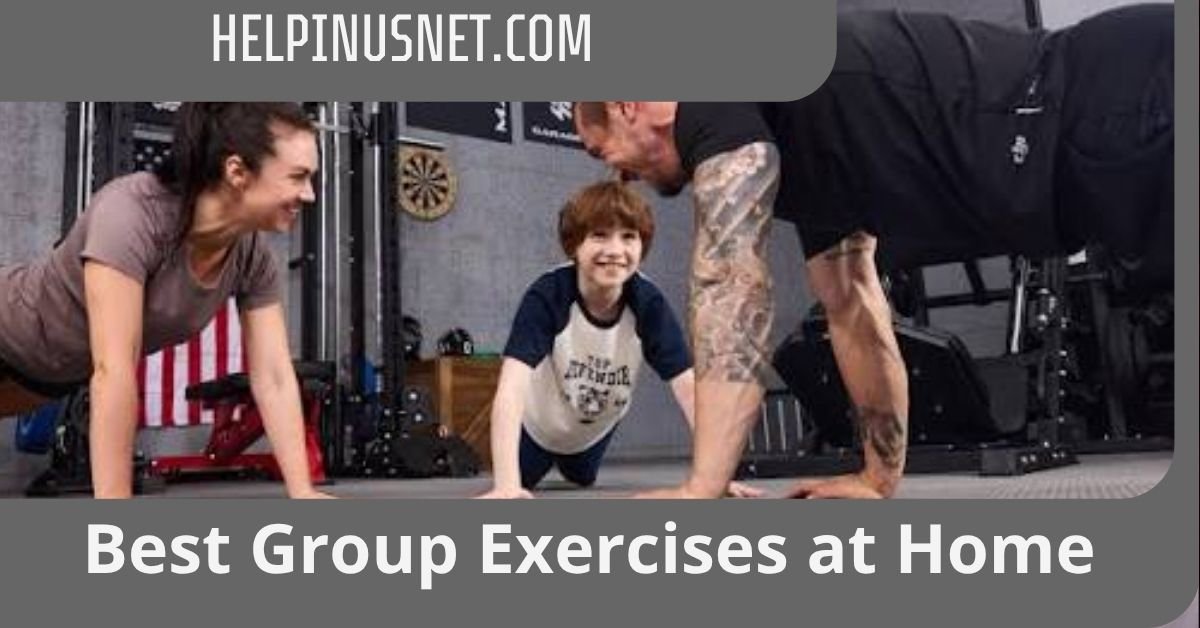
Working out at home does not have to mean exercising alone. With a little planning, a living room, backyard, garage, or other open space can become a simple and enjoyable place for a group workout. The best group exercises at home can help friends, couples, families, roommates, coworkers, and online fitness groups stay active while also making exercise more social.
Group exercise has one major advantage that many people overlook: accountability. When other people are expecting you to show up, it can be easier to stay consistent. The U.S. Physical Activity Guidelines also recognize that support from friends, family, peers, and organized groups can help people become and remain physically active.
For adults in the United States, current federal guidance recommends 150 to 300 minutes of moderate-intensity aerobic activity each week, or 75 to 150 minutes of vigorous activity, along with muscle-strengthening activities on at least two days each week. The guidelines also emphasize moving more and sitting less.
That does not mean every home group workout needs to be difficult or long. A 20- or 30-minute session can be a useful starting point. The most important factor is creating a routine that people enjoy enough to repeat.
This guide explains the best group exercises at home, how to organize them, how to adapt workouts for different fitness levels, and how to build a complete home group exercise routine without expensive equipment.
What Are Group Exercises at Home?
Group exercises at home are physical activities performed by two or more people in the same home or shared space. They can include bodyweight exercises, cardio workouts, strength training, stretching, dance, mobility exercises, fitness games, partner exercises, and circuit training.
The group does not always need to perform the exact same movement at the exact same speed.
In fact, one of the best ways to make home group exercise successful is to allow people to work at different levels.
For example, one person might perform regular squats while another uses a chair for support. One person may do standard push-ups while another performs wall push-ups. Both people are still participating in the same workout.
This makes group workouts more welcoming for beginners and more challenging for experienced participants.
Why Group Exercise at Home Is Worth Trying
Exercise is often presented as an individual activity. You put on your shoes, start a workout video, and exercise by yourself.
That approach works for many people, but it is not the only option.
A group can make exercise feel less like a chore and more like an activity you look forward to.
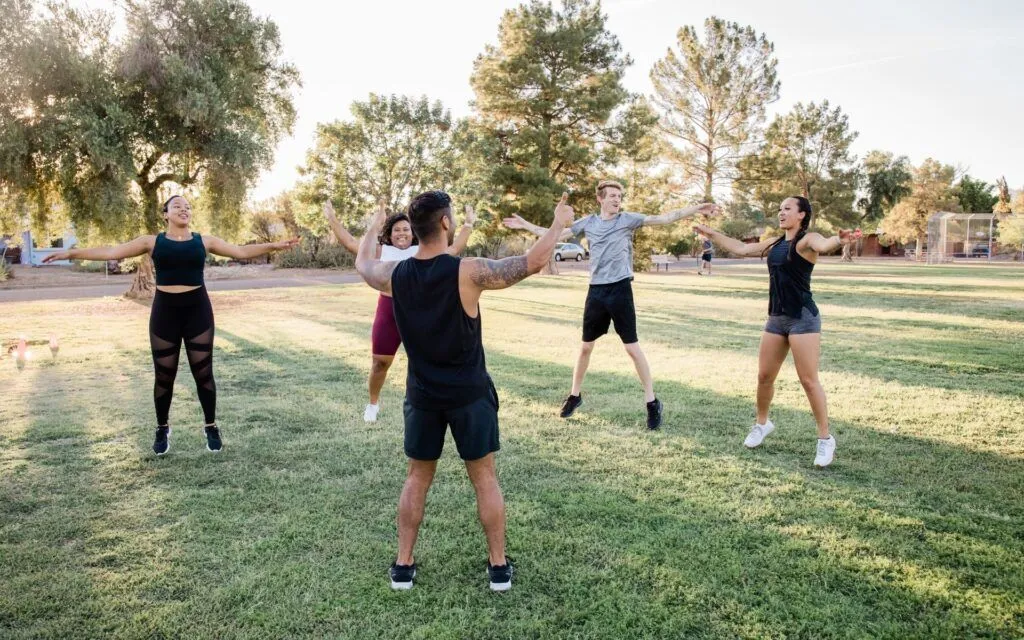
Group Workouts Can Improve Accountability
When you exercise alone, skipping one workout may feel easy.
When three friends have agreed to meet at 7 p.m. for a 30-minute workout, skipping becomes less attractive.
This simple social commitment can make consistency easier.
The American College of Sports Medicine also notes that exercise companions can provide accountability and make physical activity more enjoyable.
They Can Make Exercise More Fun
A workout does not need to feel serious every minute.
Music, friendly challenges, partner exercises, dance routines, and fitness games can make movement more enjoyable.
When people enjoy an activity, they are more likely to repeat it.
They Require Very Little Equipment
Many of the best group exercises at home use body weight.
You can build an effective session around movements such as:
- Squats
- Lunges
- Push-ups
- Glute bridges
- Planks
- Marching
- Step-ups
- Jumping jacks
- Mountain climbers
- Dancing
- Mobility exercises
If you have equipment, you can add resistance bands, dumbbells, medicine balls, or other simple tools.
However, equipment is optional for many home workouts.
They Can Support Overall Fitness
A well-designed group workout can combine several types of movement.
For example, one session can include:
- Cardio
- Lower-body strength
- Upper-body strength
- Core work
- Balance
- Mobility
- Stretching
This variety can make the workout more useful than repeating the same exercise every time.
How to Choose the Best Group Exercises at Home
The best exercise depends on the people in your group.
A workout for five athletic adults may look very different from a workout for parents and children or a group that includes beginners.
Before choosing exercises, consider four things: fitness level, available space, equipment, and individual limitations.
A good home group workout should be challenging without making participants feel pressured to compete.
The goal is not to find the person who can do the most repetitions.
The goal is to help everyone move safely and consistently.
1. Bodyweight Squats
Bodyweight squats are one of the easiest exercises to include in a group workout.
They work the muscles of the lower body, including the thighs and hips, while also teaching a basic movement pattern.
To perform a basic squat, stand with your feet around shoulder-width apart. Push your hips back and bend your knees as if you were sitting into a chair. Keep your chest comfortable and stand back up.
Beginners can squat to a chair.
More experienced participants can use a slower tempo, pause at the bottom, or hold a light weight.
For a group workout, try 10 to 15 repetitions.
The group does not have to move at exactly the same pace. Each person can rest when needed.
2. Chair Squats
Chair squats are especially useful for beginners and older adults who want extra support.
Place a sturdy chair behind you. Lower your body toward the chair and lightly touch it before standing again.
The chair gives participants a clear target and can increase confidence.
This exercise also makes a group workout more inclusive because people can adjust the depth of the squat according to their ability.
3. Reverse Lunges
Reverse lunges are another useful lower-body exercise.
Stand tall and step one foot backward. Lower your body toward the floor, then push through the front foot to return to the starting position.
Alternating legs makes the exercise easy to organize in a group.
Beginners can hold onto a wall or chair.
More advanced participants can hold dumbbells.
If regular lunges cause discomfort, reduce the range of motion or choose another lower-body exercise.
4. Glute Bridges
Glute bridges are performed on the floor and are excellent for a home workout because they require no equipment.
Lie on your back with your knees bent and feet on the floor. Lift your hips, squeeze your glutes gently, and lower your hips with control.
Try 10 to 15 repetitions.
For a group challenge, everyone can perform the same number of controlled repetitions rather than racing.
Quality is more important than speed.
5. Push-Ups
Push-ups are a classic upper-body and core exercise.
However, traditional floor push-ups can be difficult for beginners.
That is why a group workout should include different versions.
Participants can choose from:
- Wall push-ups
- Counter push-ups
- Knee push-ups
- Standard push-ups
The movement should remain controlled.
A beginner who performs eight good wall push-ups is participating just as successfully as an advanced person performing eight standard push-ups.
6. Wall Push-Ups
Wall push-ups are one of the simplest ways to introduce pushing exercises.
Stand facing a wall with your hands against it. Bend your elbows and bring your chest toward the wall. Push yourself back.
They are easy to perform in a small space and require little strength compared with floor push-ups.
They can be particularly helpful when a group includes people with different fitness levels.
7. Planks
Planks are popular because they require no equipment and can be adjusted to different ability levels.
A standard plank involves supporting the body on the forearms or hands while maintaining a stable body position.
Beginners can perform a plank from the knees.
Another option is an elevated plank with the hands on a sturdy surface.
Instead of competing to see who can hold a plank the longest, consider using short intervals such as 15 to 30 seconds.
This makes the exercise easier to manage and keeps technique under control.
8. Bird Dogs
Bird dogs are a good choice when you want to add controlled core and balance work.
Start on your hands and knees. Slowly extend one arm and the opposite leg. Return them to the starting position and switch sides.
The movement should be slow.
This exercise works well in group sessions because participants can focus on control rather than speed.
9. Dead Bugs
Dead bugs are another beginner-friendly core exercise.
Lie on your back with your arms raised and knees bent. Slowly lower one arm and the opposite leg while keeping control of your trunk. Return to the starting position and switch sides.
If the full movement is too difficult, move only the arms or only the legs.
10. Marching in Place
Marching in place is one of the easiest cardio exercises for a home group.
It requires almost no space and can be adjusted for different fitness levels.
Beginners can march slowly.
More advanced participants can increase the pace and raise their knees higher.
You can also turn marching into a warm-up before strength exercises.
11. Step Touch
Step touch is a simple side-to-side movement that works well with music.
Step to one side, bring the other foot toward it, then repeat on the opposite side.
It can become more challenging by adding arm movements or increasing the pace.
This is a great option for people who do not enjoy traditional gym exercises.
12. Jumping Jacks
Jumping jacks are a familiar cardio movement that can raise the heart rate quickly.
However, not everyone needs to jump.
A low-impact version involves stepping one foot out at a time while moving the arms.
This is an important principle for group fitness: offer a lower-impact option instead of assuming everyone should perform the hardest version.
13. Low-Impact Jacks
Low-impact jacks are ideal for mixed groups.
Step one foot to the side while lifting the arms, return to center, and alternate sides.
They can provide a cardio challenge without requiring repeated jumping.
This can make them a useful choice for small spaces or groups that prefer lower-impact exercise.
14. Mountain Climbers
Mountain climbers can provide a higher-intensity challenge.
Start in a plank position and bring one knee toward your chest, then switch sides.
For beginners, slow the movement down.
For a lower-impact version, place your hands on a sturdy elevated surface.
Because mountain climbers can become intense quickly, they are best used for short intervals.
15. High-Knee Marches
High-knee marching is a simple way to increase movement intensity.
Lift one knee at a time while maintaining good posture.
You can use a timer for 20 to 40 seconds.
Participants who want more intensity can increase their pace.
Those who need less intensity can slow down.
16. Dance Workouts
Dance may be one of the best group exercises at home for people who find traditional exercise boring.
You can create a simple routine using:
- Step touches
- Side steps
- Marching
- Knee lifts
- Arm movements
- Turns
- Easy dance combinations
The goal does not have to be perfect choreography.
A group dance workout can focus on moving continuously and enjoying the music.
17. Follow-the-Leader Workouts
Follow-the-leader is an easy way to make home exercise more interactive.
One person leads for 30 to 60 seconds.
They choose a simple movement such as marching, squatting, stepping, dancing, or arm movements.
Then another person becomes the leader.
This format works especially well with families and friends because it adds variety without requiring complicated programming.
18. Partner Squats
Partner squats can add a social element to a basic exercise.
Two people face each other and perform controlled squats at the same time.
They can use each other only as a visual rhythm cue rather than pulling or pushing.
For safety, avoid using another person as unstable support.
The exercise should remain controlled and comfortable.
19. Partner Plank High-Fives
Two people can face each other in a plank position and perform alternating high-fives if they have enough balance and space.
This is better suited to people who already have basic plank control.
A simpler version is to perform the plank independently while giving a high-five between rounds.
The goal is fun and coordination rather than showing off.
20. Resistance Band Exercises
If your group has resistance bands, you can add several strength exercises.
Useful options include:
- Band rows
- Band squats
- Band chest presses
- Lateral band walks
- Biceps curls
- Shoulder exercises
Resistance bands are convenient because they take up little storage space.
When exercising as a group, make sure each participant understands how to anchor or hold the band safely.
21. Resistance Band Rows
A resistance band row works the upper back and arms.
Depending on the band and setup, participants can pull the handles or band toward their body while keeping control.
Avoid anchoring a band to an object that could move or break.
If the group is new to resistance bands, start with light resistance and simple movements.
22. Lateral Band Walks
Place a resistance band around the legs according to the band’s instructions and take controlled steps sideways.
This can add variety to lower-body training.
Participants should use enough resistance to feel challenged without losing control.
23. Dumbbell Circuits
If everyone has access to light dumbbells, a simple circuit can include:
- Goblet squats
- Dumbbell rows
- Shoulder presses
- Romanian deadlift patterns
- Biceps curls
The weights do not need to be heavy.
The focus should be controlled movement and proper technique.
People with different strength levels can use different weights while following the same circuit.
24. Bodyweight Circuit Training
Circuit training is one of the best formats for group exercises at home.
A circuit may include five or six exercises.
For example:
- Squats
- Wall push-ups
- Marching
- Glute bridges
- Bird dogs
- Step touches
Perform each exercise for 30 seconds, rest briefly, and move to the next exercise.
After completing the circuit, rest for one or two minutes and repeat.
The biggest advantage is flexibility.
Participants can adjust the intensity of each movement without changing the entire workout.
25. Cardio Intervals
Cardio intervals alternate periods of activity with easier movement or rest.
For example:
- 30 seconds fast marching
- 30 seconds easy marching
- 30 seconds step touches
- 30 seconds easy marching
Repeat the sequence several times.
This is often easier for beginners than performing high-intensity exercise continuously.
The talk test can also help people judge intensity. Moderate activity generally allows conversation, although breathing is faster; vigorous activity makes conversation more difficult.
26. Home Walking Challenges
You do not need complicated exercises to create a group fitness challenge.
Set a daily or weekly walking goal and encourage everyone to participate.
If weather permits, the group can walk outdoors together. If not, participants can walk around the home, march in place, or use another indoor movement option.
A group walking challenge can be especially useful for people who dislike traditional workouts.
27. Mobility Sessions
Not every group workout needs to be intense.
A mobility session can include controlled movements for the shoulders, hips, ankles, spine, and other areas.
Examples include:
- Shoulder circles
- Hip circles
- Gentle torso rotations
- Ankle movements
- Controlled leg swings
- Cat-cow movements
Mobility work can be used as a warm-up, cool-down, or separate low-intensity session.
28. Group Yoga at Home
Yoga can work well for groups because participants can follow the same general sequence while choosing easier or more advanced versions.
A home yoga session might include:
- Breathing exercises
- Gentle warm-up movements
- Standing poses
- Balance exercises
- Floor movements
- Relaxation
Beginners should not feel pressured to match someone else’s flexibility.
29. Group Stretching
Stretching can be a relaxing way to finish a group workout.
Focus on comfortable positions rather than forcing a stretch.
Slow breathing can help make the session feel calmer.
A group stretching session can also be useful on recovery days when participants want to move without doing a demanding workout.
30. Fitness Games
Fitness games can make exercise especially enjoyable for children and families.
Some ideas include:
- Movement bingo
- Exercise charades
- Follow-the-leader
- Balance challenges
- Dance freeze games
- Movement dice
- Timed activity stations
The activities should be age-appropriate and safe.
The objective is to make movement enjoyable rather than turn every workout into a competition.
How to Build a 30-Minute Group Workout at Home
A simple 30-minute workout can provide structure without taking too much time.
Minutes 1 to 5: Warm-Up
Start with easy movements.
Try:
- Marching
- Arm circles
- Step touches
- Gentle knee lifts
- Shoulder rolls
The purpose is to gradually prepare the body for exercise.
Minutes 6 to 20: Main Circuit
Choose five exercises.
For example:
- Squats
- Wall or floor push-ups
- Marching
- Glute bridges
- Bird dogs
Perform each movement for about 30 to 45 seconds.
Rest as needed.
Repeat the circuit two or three times.
Minutes 21 to 26: Cardio Challenge
Choose one or two movements.
Examples include:
- Fast marching
- Step touches
- Low-impact jacks
- Dancing
- High-knee marching
Use short work periods followed by recovery.
Minutes 27 to 30: Cool-Down
Slow the movement down.
Add gentle stretching and controlled breathing.
This structure is simple enough for beginners but flexible enough for experienced participants.
A Beginner Group Workout Plan
For a group that is new to exercise, start slowly.
A beginner session might include:
- 5 minutes of easy warm-up
- 10 chair squats
- 8 wall push-ups
- 10 glute bridges
- 20 seconds marching
- 6 bird dogs per side
- 30 seconds rest
- Repeat two or three times
- 5 minutes of gentle cool-down
The exact number of repetitions is not as important as good technique and consistency.
Someone who is completely new to exercise may need additional rest.
That is normal.
A More Challenging Group Workout Plan
For a more experienced group, use a circuit with:
- 12 squats
- 10 push-ups
- 12 reverse lunges
- 30 seconds mountain climbers
- 12 glute bridges
- 30 seconds high-knee marching
- 30 seconds plank
Rest for one to two minutes after the circuit.
Complete two to four rounds depending on fitness level.
Again, people do not need to use identical modifications.
A Low-Impact Group Workout
Low-impact exercise can still be effective.
Try:
- Marching in place
- Step touches
- Chair squats
- Wall push-ups
- Glute bridges
- Bird dogs
- Standing knee lifts
- Gentle mobility exercises
Low-impact does not mean ineffective.
The intensity can be increased through longer work periods, faster controlled movement, resistance bands, or additional rounds.
How Often Should You Do Group Exercises at Home?
There is no single schedule that works for everyone.
For adults, the federal target is 150 to 300 minutes of moderate aerobic activity each week, or 75 to 150 minutes of vigorous activity, plus muscle-strengthening activity on at least two days each week.
A practical weekly plan might look like this:
Monday: 30-minute group circuit
Tuesday: 20- to 30-minute walk
Wednesday: 30-minute strength workout
Thursday: Rest or gentle mobility
Friday: 30-minute dance or cardio workout
Saturday: Group walk or recreational activity
Sunday: Rest or gentle stretching
You can adjust this plan based on your schedule and fitness level.
How to Make Group Workouts Work for Different Fitness Levels
This is one of the most important parts of group exercise.
If everyone is expected to perform the same movement in exactly the same way, beginners may feel uncomfortable while experienced participants may become bored.
Instead, create levels.
For squats:
Beginner: chair squat
Intermediate: bodyweight squat
Advanced: weighted squat
For push-ups:
Beginner: wall push-up
Intermediate: incline or knee push-up
Advanced: standard push-up
For cardio:
Beginner: marching
Intermediate: fast marching
Advanced: high knees or another more demanding option
This approach lets everyone participate together.
Should Group Workouts Be Competitive?
Friendly competition can motivate some people.
It can discourage others.
The best approach is to make competition optional.
Instead of asking who can do the most repetitions, consider group goals.
For example:
“Can we complete 10 total minutes of movement?”
“Can everyone complete two rounds?”
“Can we exercise together three times this week?”
These goals encourage teamwork.
How to Keep Home Group Workouts Interesting
Repeating the same workout every day can become boring.
Rotate different styles.
One day can focus on strength.
Another can focus on dance.
Another can include mobility.
Another can be a walking challenge.
You can also change the music, workout leader, exercise order, or time intervals.
Variety is useful not only for enjoyment but also because different activities challenge the body in different ways. Federal guidance encourages adults to include different types of activity and avoid doing only one kind of exercise repeatedly.
How to Use Music During Group Exercise
Music can make a home workout feel more like a group event.
Create a playlist before the workout begins.
Choose music that matches the group.
For interval training, you can use songs to structure the workout.
For example, one song can be the main workout and the next can be recovery.
Dance workouts can be built almost entirely around music.
Remember to keep the volume at a level where participants can still communicate.
Best Group Exercises for Families
Family workouts should focus on fun and movement rather than intense training.
Good choices include:
- Dancing
- Walking
- Follow-the-leader
- Movement games
- Step touches
- Animal walks
- Balloon games
- Easy squats
- Balance activities
Children generally need much more daily physical activity than adults, so family movement can be a useful way to make activity part of everyday life. Current federal guidance recommends at least 60 minutes of moderate-to-vigorous physical activity each day for children and adolescents ages 6 through 17.
Best Group Exercises for Couples
Couples can use short workouts that fit easily into a busy schedule.
A simple 20-minute session could include:
- Squats
- Reverse lunges
- Push-ups
- Glute bridges
- Marching
- Planks
You can alternate who chooses the next exercise.
Another option is to take a walk together after dinner.
The best routine is the one that both people can maintain.
Best Group Exercises for Older Adults
Older adults can benefit from aerobic, strengthening, and balance activities.
The federal guidelines specifically recommend multicomponent physical activity for older adults, including aerobic, muscle-strengthening, and balance training.
Useful home options may include:
- Chair stands
- Supported squats
- Wall push-ups
- Marching
- Heel raises
- Balance exercises near a sturdy support
- Gentle mobility
- Walking
People with health conditions, significant balance problems, or concerns about starting exercise should talk with a qualified healthcare professional about appropriate activity.
Home Group Exercise Safety Tips
Safety should always come before intensity.
Clear enough space before beginning.
Move furniture, cords, toys, and other objects that could cause trips.
Use a stable surface.
Wear appropriate footwear when needed.
Do not exercise through sharp or unusual pain.
Take breaks when necessary.
Keep water available.
If someone becomes dizzy, unusually short of breath, confused, or feels unwell, stop the activity and address the situation.
People who are pregnant, have a chronic medical condition, have an injury, or have other health concerns may need individualized guidance before starting or changing an exercise program.
Why Beginners Should Not Copy Advanced Participants
One of the biggest mistakes in group exercise is comparing yourself with the strongest person in the room.
An advanced participant may perform 20 push-ups.
A beginner may perform five wall push-ups.
That does not make the beginner unsuccessful.
Exercise should create an appropriate challenge for the individual.
Progress can happen by increasing repetitions, improving technique, adding resistance, increasing time, or gradually reducing rest.
It does not have to happen immediately.
How to Progress Your Group Workout
Once the workout becomes comfortable, change only one or two variables at a time.
You could:
- Add another round
- Increase exercise time
- Add light resistance
- Increase repetitions
- Reduce rest slightly
- Choose a more difficult variation
Do not increase everything at once.
A gradual approach is easier to maintain and can reduce unnecessary fatigue.
Common Mistakes in Home Group Exercise
Making Every Workout Too Hard
A workout does not need to leave everyone exhausted to be useful.
Very difficult sessions may reduce motivation and make recovery harder.
Ignoring Beginners
If beginners cannot participate comfortably, they may stop joining.
Always provide easier variations.
Turning Everything Into a Competition
Competition can be fun, but constant comparison can create pressure.
Team-based goals are often more welcoming.
Skipping the Warm-Up
Starting immediately with intense movements may not be appropriate for everyone.
Spend several minutes gradually increasing movement.
Using Unsafe Equipment
Do not attach resistance bands to weak furniture, doors, or other unstable objects.
Use equipment according to its instructions.
Focusing Only on Cardio
Cardio is valuable, but a complete fitness routine should also include muscle-strengthening activity.
Doing the Same Workout Every Day
A mix of activities can keep exercise interesting and help develop different aspects of fitness.
How to Organize a Weekly Home Fitness Group
If several people want to exercise together regularly, create a simple schedule.
For example:
Monday: Full-body strength
Wednesday: Cardio and dance
Friday: Full-body circuit
Saturday: Walking or recreational activity
The group can also choose a leader for each session.
One person can organize Monday.
Another can lead Wednesday.
Another can choose Friday’s workout.
This spreads responsibility across the group.
How Technology Can Improve Home Group Workouts
Technology can make remote group exercise possible.
Friends who live in different homes can join the same video workout.
You can also use fitness trackers, timers, shared calendars, or group chats to stay accountable.
Technology should support the habit rather than become the focus.
A simple group message such as “Workout starts in 10 minutes” can be enough to remind everyone to participate.
The Physical Activity Guidelines also identify technology and social support as strategies that can help people increase physical activity.
Best Equipment for Group Exercises at Home
You do not need a home gym.
If you want to add equipment, start with versatile items.
Useful choices include:
- Resistance bands
- Light dumbbells
- Exercise mats
- A sturdy chair
- Step platform
- Yoga blocks
- Timer
A resistance band can provide many exercise options while taking very little storage space.
Dumbbells can add resistance to squats, rows, presses, and other movements.
But bodyweight exercise remains an excellent starting point.
How to Create a 15-Minute Group Workout
Short workouts can be useful when everyone is busy.
Try:
2 minutes: warm-up
2 minutes: squats
2 minutes: push-up variations
2 minutes: marching
2 minutes: glute bridges
2 minutes: alternating lunges
2 minutes: easy cardio
1 minute: cool-down
This type of session is easy to fit into a lunch break, morning routine, or evening schedule.
Short workouts can also help people build confidence before moving toward longer sessions.
How to Create a 45-Minute Group Workout
For a longer session:
5 minutes: warm-up
10 minutes: lower-body strength
10 minutes: upper-body and core exercises
10 minutes: cardio intervals
5 minutes: mobility
5 minutes: cool-down
This structure gives the workout a clear beginning, middle, and end.
The Best Group Exercise Is the One People Will Repeat
There is no single exercise that deserves the title of “best” for everyone.
The best group exercise is the activity that fits the group, can be performed safely, and is enjoyable enough to repeat.
A group of dancers may prefer music.
A family may prefer games.
A group of coworkers may prefer a 20-minute circuit.
Older adults may prefer walking, chair exercises, mobility, and balance work.
Athletic friends may enjoy challenging circuits.
Fitness should fit the people doing it.
A Practical Group Exercise Formula
If you want to design your own home workout, use this simple formula:
Start with a warm-up.
Choose one lower-body exercise.
Choose one upper-body exercise.
Choose one core exercise.
Add a cardio movement.
Finish with mobility or stretching.
For example:
Warm-up: marching
Lower body: squats
Upper body: wall push-ups
Core: bird dogs
Cardio: step touches
Cool-down: gentle stretching
This formula can produce dozens of different workouts simply by changing the exercise variations.
How to Make Group Exercise a Long-Term Habit
Motivation is useful, but routines are more reliable.
Choose a regular day and time.
Keep the workout simple.
Prepare the space beforehand.
Have a backup plan for busy days.
Celebrate consistency instead of perfection.
If someone misses a session, they should simply return to the next one.
There is no need to “make up” missed workouts with excessive exercise.
The goal is long-term participation.
Frequently Asked Questions About Best Group Exercises at Home
1. What is the best group exercise to do at home?
There is no single best exercise for every group. Full-body circuits, dancing, walking, bodyweight exercises, resistance-band workouts, and mobility sessions are all useful options. The best choice is one that matches the group’s fitness levels, available space, goals, and interests.
2. Can group exercises at home help with weight management?
Regular physical activity can support healthy weight management, especially when combined with appropriate eating habits and adequate sleep. However, results vary between individuals. Exercise should be viewed as part of an overall healthy lifestyle rather than a guaranteed method for reaching a particular body weight.
3. How many people do you need for a group workout?
You only need two people to exercise as a group. A group can include a couple, several friends, family members, roommates, or coworkers. Larger groups can also work if there is enough space and the workout is organized properly.
4. What are good group exercises for people who dislike working out?
Dance, walking games, follow-the-leader activities, fitness games, and music-based workouts may feel less like traditional exercise. Choosing enjoyable activities can make it easier to stay consistent.
5. Can I do group workouts without any equipment?
Yes. Many effective home group exercises use body weight only. Squats, lunges, push-up variations, planks, glute bridges, marching, step touches, bird dogs, and dancing can all be performed without a home gym.
Final Thoughts
The best group exercises at home do not require an expensive gym, complicated equipment, or advanced fitness skills. A few people, a little open space, and a simple plan can be enough to create an enjoyable workout.
Bodyweight squats, push-ups, lunges, glute bridges, planks, marching, dancing, resistance-band exercises, mobility work, and circuit training can all become part of a practical home fitness routine. More importantly, group exercise can provide something that a solo workout sometimes lacks: connection, encouragement, accountability, and fun.
Current U.S. physical activity guidance recommends regular aerobic activity, muscle-strengthening work, and less sedentary time, while also recognizing the value of support from others. The smartest approach is not to chase the hardest workout. It is to create a safe, enjoyable routine that everyone can adapt to their own level and continue week after week.
